
Public-registry search and alerts
National Offender Map
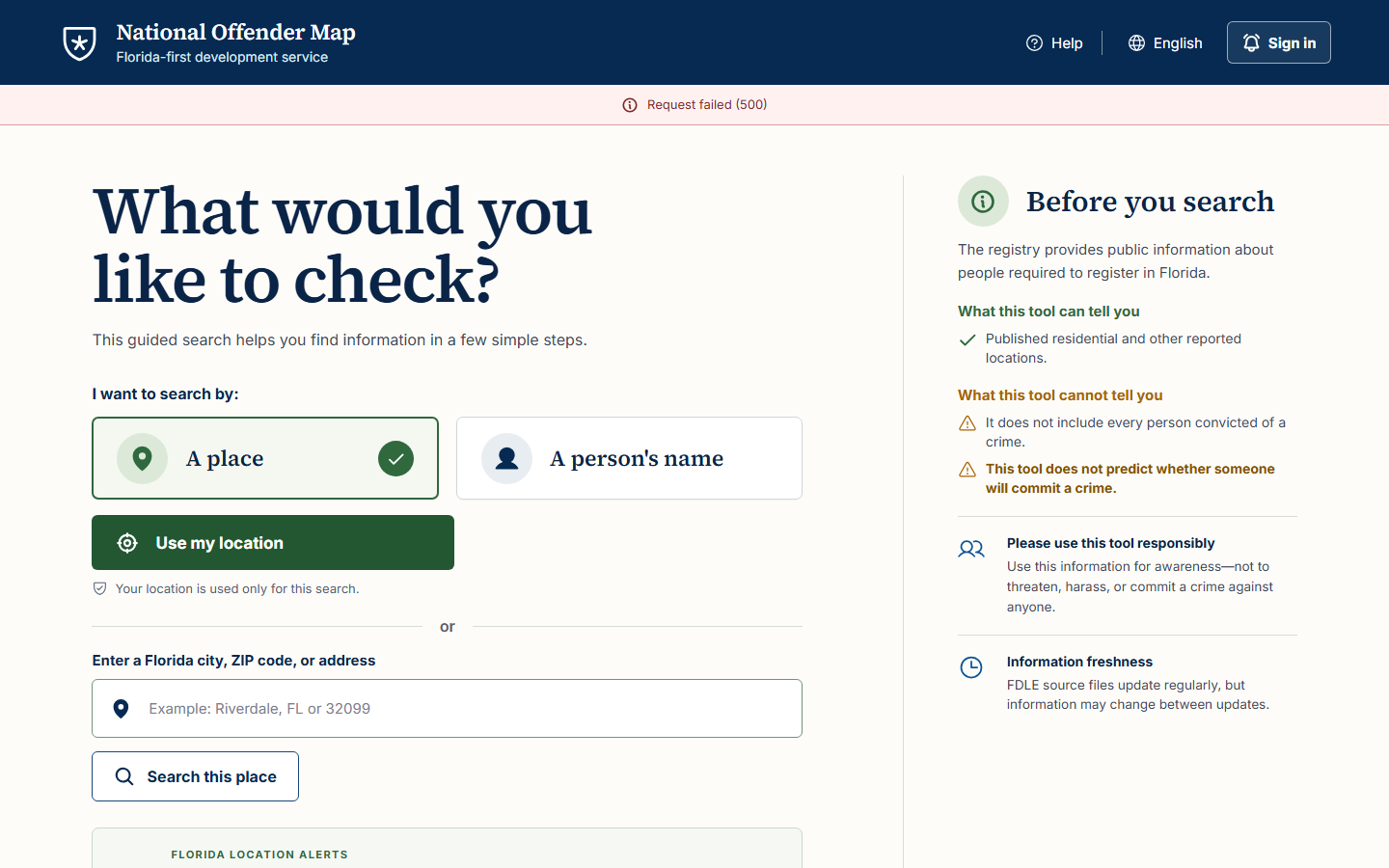
National Offender Map is a mobile-first, independent public-registry product designed to make Florida records easier to search by place, ZIP code, coordinates, or name. It combines list and map views with saved-area alerts while keeping the official FDLE source, data freshness, and responsible-use limits visible.
Verified local MVP; public launch not complete
Project snapshot
- Built for
- People reviewing Florida public-registry information by location or name
- Core workflow
- Search → compare map and list context → verify with FDLE → optionally save an area for change alerts
- Current state
- Local MVP with validated Florida import; durable hosted production remains open
What the product actually does
Search and mapping with source context
The interface supports place, ZIP, coordinate, and name search, browser geolocation, responsive list and Leaflet map views, geocoded published locations, and direct links to the official FDLE record search. Development mode uses two explicitly synthetic records and labels them so they cannot be mistaken for live registry data.
Saved locations and change alerts
Passwordless accounts can store multiple Florida areas with separate radii. The ingestion pipeline accepts a full public file, detects later address additions, changes, and removals, geocodes changed published locations, matches them to saved areas, and queues deduplicated email events. A baseline import intentionally creates no move alerts.
A careful public-data boundary
Records absent from a valid later full-state file are deactivated rather than erased, and an empty full-state file is rejected before it can deactivate data. Photos remain hosted by FDLE rather than being copied into application storage. The interface states that an address record does not track live movement, establish present danger, predict behavior, or justify harassment.
BroadBuilder’s role
What BroadBuilder delivered
BroadBuilder developed the responsive search and map interface, local API, passwordless sessions, saved areas, import and change-detection pipeline, geocoding queue, notification outbox, synthetic-data safeguards, source links, and responsible-use language.